


The Satyricon And The Apocolocyntosis
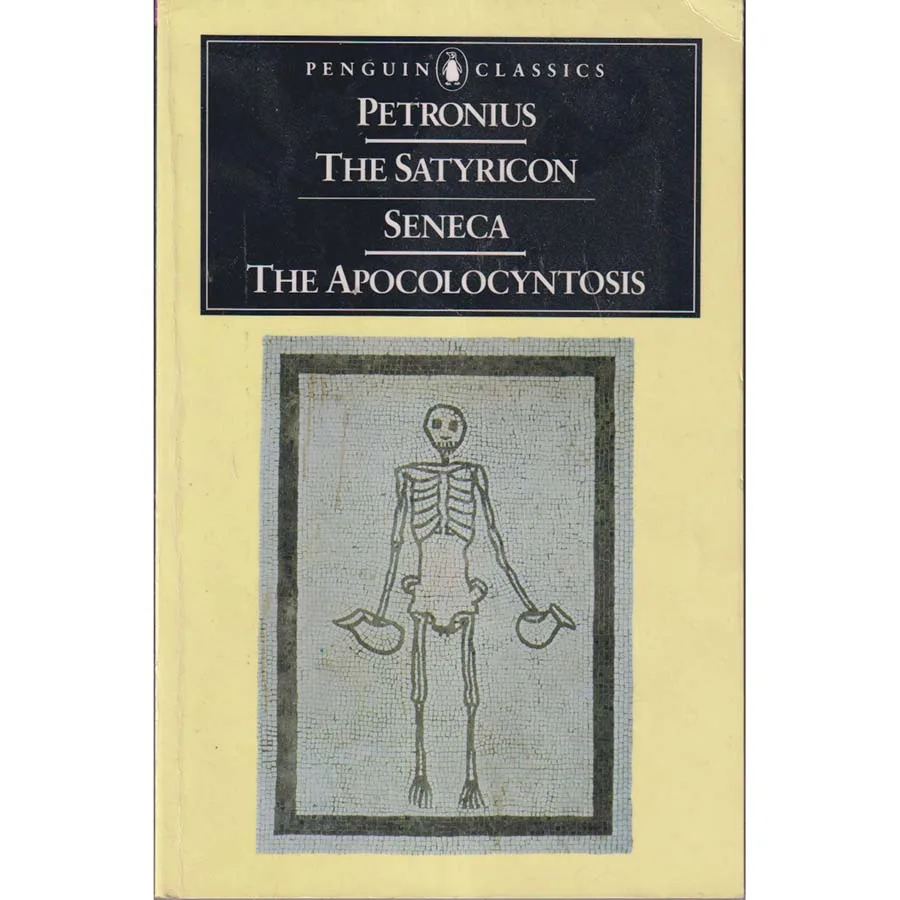
Publisher: Penguin Classics
Format: Paperback
ISBN: 9780140444896
Ancient Rome is often presented to us as a dignified procession of emperors, senators, marble temples and men wearing sheets with tremendous authority. The Satyricon and The Apocolocyntosis offer a useful corrective. Here Rome is populated by frauds, flatterers, social climbers, gluttons, sexual adventurers, pompous millionaires and dead emperors discovering that the gods are no more impressed with them than anyone else. Civilisation may have built the aqueducts, but it also produced some exceptionally vulgar dinner parties.
The Satyricon, attributed to Petronius, survives only in fragments, although they are sufficiently energetic fragments to suggest that the complete work must have been quite a spectacle. Its disreputable characters wander through a shifting world of dubious lodging houses, romantic complications, petty schemes, literary arguments and social humiliation. At its centre is the famous banquet of Trimalchio, a wealthy former slave whose money has arrived rather sooner than his taste. He overwhelms his guests with food, entertainment and increasingly heroic demonstrations of the fact that he can afford things.
Trimalchio’s dinner is one of literature’s great portraits of conspicuous consumption. Nothing is permitted to be merely served when it could instead be disguised, decorated, announced, performed or made to emerge unexpectedly from something else. The host talks incessantly, the guests flatter him dutifully and the evening develops the unmistakable atmosphere of a party at which everyone wishes to leave but nobody wants to be the first person to risk offending the man paying for it.
Seneca’s The Apocolocyntosis is shorter but no more respectful. Its title is usually understood as a joke on “apotheosis”, the process by which a dead emperor was declared divine, except that the unfortunate Emperor Claudius is subjected to something closer to “pumpkinification”. Instead of being welcomed into heaven as a new god, Claudius encounters ridicule, rejection and a celestial administrative process that treats his imperial dignity as a claim requiring further investigation.
Together, the two works reveal Romans behaving with all the greed, vanity, insecurity and determination to impress that humanity has carefully preserved into the modern age. Petronius attacks social pretension from the dining room upward, while Seneca imagines the afterlife as a place where an emperor’s status, connections and official publicity finally cease to help. It is satire written with a knife, though occasionally the knife is being used to cut an unnecessarily elaborate roast animal.
This 1984 Penguin Classics edition is an ex-school copy from Old Palace School in Croydon. It still has its borrowing label inside the front, ready to record generations of eager pupils taking Roman satire home for private enjoyment. Remarkably, nobody ever did. The label remains blank: a small, immaculate monument to unrealised educational ambition. The book waited patiently to be borrowed, but the pupils of Old Palace apparently resisted Petronius and Seneca with the discipline of Roman legionaries.
Their restraint has been excellent news for the book itself. Although graded Good because of its ex-school status and identifying label, it is in unusually well-preserved condition and appears to have escaped the traditional ordeals of school-library life. It has not been hauled repeatedly between classroom and home, crushed beneath sports equipment or abandoned beside an opened yoghurt. In practical terms, it is a remarkably tidy copy whose institutional history is more visible in the label than in any evidence of actual reading.
This is an ideal volume for students of Roman literature, classical satire, imperial absurdity, outrageous banquets or the ancient origins of laughing at rich and powerful people. It is also suitable for anyone who likes Penguin Classics but prefers their antiquity filled with crooked schemes, bad manners and prominent citizens making complete fools of themselves.
A very well-preserved Good ex-school copy sold by Crappy Old Books—officially available for borrowing since the 1980s, but apparently awaiting its first genuinely interested reader until now.
Keep browsing: See more Ancient Classics books Other books by Lucius Seneca and Petronius Annaeus
